
Availability
Available for gallery display
Available for science & outreach events
Licensed use on request
Available (price varies by size)
In a Nutshell
Spiral Galaxy
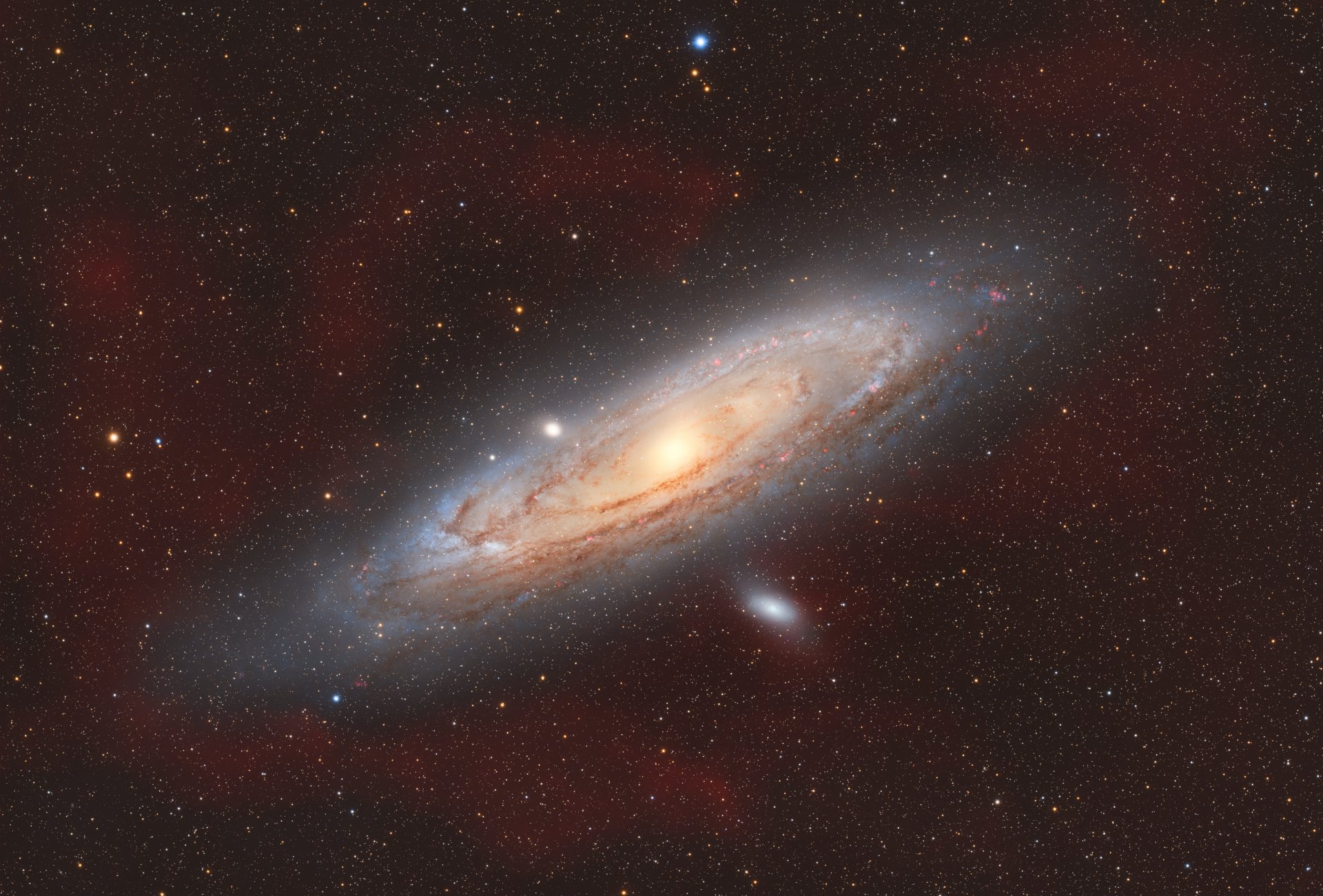
M31 (NGC 224) — Andromeda Galaxy
Northern
Andromeda
~2.5 million light-years
Technical Details
ZWO AM5
RedCat 51
ZWO ASI294MC-Pro
Optolong L-Pro + L-Ultimate
WO Uniguide 32
ZWO ASI220MM Mini
ZWO ASIAIR Plus
54 h 30 m
PixInsight
Luxembourg
The Andromeda Galaxy: Our Celestial Neighbour
A deep dive into the most distant object visible to the naked eye.
On a clear, dark autumn night, far from the glare of city lights, you might spot a faint, fuzzy patch of light in the constellation Andromeda. This unassuming smudge is anything but humble. It is the Andromeda Galaxy (M31), a vast “island universe” of stars, gas, and dust, and the closest major galaxy to our own Milky Way. At a staggering 2.5 million light-years away, the light reaching your eyes tonight began its journey when our earliest human ancestors roamed the Earth.
“We are stardust, looking back at the stars.”
A “Small Cloud” in the Stars: Discovery and Observation
While it only entered the Western scientific ledger in the 17th century, M31 has been known for millennia. Its earliest confirmed record dates to 964 by the Persian astronomer Abd al-Rahman al-Sufi, who described it as a “small cloud” in his Book of Fixed Stars. It was later “discovered” independently by the German astronomer Simon Marius in 1612, who provided the first telescopic observation.
For centuries, its true nature was a subject of intense debate. Charles Messier catalogued it as M31 in 1764, famously (and incorrectly) believing it to be a nebula within our own galaxy. This “Great Debate” culminated in the 1920s with the work of American astronomer Edwin Hubble. Using the powerful 100-inch Hooker telescope at Mount Wilson Observatory, Hubble identified specific types of pulsating stars within M31. These Cepheid variables allowed him to calculate their distance, proving conclusively that Andromeda was not a nearby cloud, but a separate, colossal galaxy far beyond the bounds of the Milky Way.
The Anatomy of a Spiral: Main Structure and Composition
Andromeda is classified as a large spiral galaxy, specifically type SA(s)b. Like our Milky Way, it features a bright central bulge, a rotating disc of stars and gas, and a vast, faint halo. It spans an incredible 220,000 light-years from tip to tip, making it significantly larger than the Milky Way’s estimated 100,000 light-year diameter.
The galaxy is tilted from our perspective, giving us a magnificent, oblique view of its structure. Its disc is populated with sweeping spiral arms, traced by bright blue regions of active star formation, and dark lanes of interstellar dust that obscure the light from stars behind them. At its very centre lies a supermassive black hole, estimated to be 100–200 million solar masses—significantly more massive than the Milky Way’s central black hole.
Surrounding the entire disc is the halo, a vast, tenuous sphere of hot gas, stars, and dark matter extending perhaps halfway to our own galaxy. Studies, particularly from the Hubble Space Telescope, reveal that M31’s halo is massive and layered, likely built from the shredded remains of smaller galaxies it has consumed over billions of years.
A Tale of a Trillion Suns: Star Population
M31 is a stellar metropolis, home to an estimated one trillion stars—roughly double the estimate for the Milky Way. The central bulge is dominated by older, redder stars, while the spiral arms are rich in gas and dust, the raw materials for new stars. These arms blaze with the light of hot, young, blue stars, which live fast and die young, seeding the next generation with heavy elements.
One curious feature of Andromeda’s core is its “double nucleus”—two distinct bright spots at its heart. Modern observations suggest it is a ring of old, red stars orbiting the central black hole in an eccentric pattern, likely tied to the remnants of a smaller galaxy cannibalised by Andromeda long ago.
Recent Discoveries: A Violent Past
Modern astronomy continues to peel back Andromeda’s layers, revealing a history more violent than previously thought. Unlike the relatively placid Milky Way, Andromeda’s disc appears “puffy” and its stars more chaotically distributed—signs of significant mergers. The deep, wide-field PAndAS survey uncovered gigantic, faint stellar streams and dwarf satellites, the tidal wreckage of smaller galaxies torn apart by M31’s gravity. This directly supports the hierarchical model of galaxy formation.
The Great Collision: Future Evolution
Andromeda is hurtling towards the Milky Way at ~110 km/s. Data from Hubble and Gaia confirm that a direct collision is inevitable in ~4.5 billion years. After a series of passes, the galaxies will merge into a single, colossal elliptical often dubbed “Milkomeda”.
Despite the drama, stars are unlikely to collide—the vast distances between them make direct impacts rare. Instead, gravity will reshape orbits; the Sun may be flung into a new, more distant path, while the night sky will undergo a breathtaking transformation.
M31 vs. Milky Way: Tale of the Tape
| Characteristic | Milky Way | Andromeda (M31) |
|---|---|---|
| Galaxy Type | Barred Spiral (SBbc) | Spiral (SA(s)b) |
| Diameter | ~100,000 light-years | ~220,000 light-years |
| Est. Star Count | 200–400 billion | ~1 trillion |
| Est. Mass | ~1.5 trillion M☉ (incl. DM) | ~1.76 trillion M☉ (incl. DM) |
| Central Black Hole | ~4 million M☉ | ~100–200 million M☉ |
| Distance | — | ~2.5 million light-years |
How to Observe Andromeda (M31)
When to Look: Northern Hemisphere, August–February; highest in autumn nights.
Using Cassiopeia: Find the “W” and follow the right-hand “V” (Schedar–Ruchbah) about 15° to a faint oval glow.
- Naked Eye: Faint elongated smudge in dark skies (Bortle 1–4).
- Binoculars (e.g., 10×50): Bright core with diffuse halo.
- Telescope: Core plus companions M32 and M110; very large apertures may hint at dust lanes under excellent skies.
Seeing Andromeda is a visceral reminder of our place in a vast, evolving universe.
References
- Ribas, I., et al. (2005). The Astrophysical Journal Letters, 635(1), L37–L40.
- Kepple, G. R., & Sanner, G. W. (1998). The Night Sky Observer’s Guide, Vol. 1.
- Marius, S. (1612). Mundus Iovialis.
- Messier, C. (1771). Catalogue des Nébuleuses et des amas d’Étoiles.
- Hubble, E. P. (1929). The Astrophysical Journal, 69, 103–158.
- Lehner, N., et al. (2020). The Astrophysical Journal, 900(1), 1.
- Ibata, R. A., et al. (2014). The Astrophysical Journal, 780(2), 128.
- Van der Marel, R. P., et al. (2012). The Astrophysical Journal, 753(1), 7.
- Cox, T. J., & Loeb, A. (2008). Monthly Notices of the Royal Astronomical Society, 386(1), 461–474.
- Additional references as listed in the original article.


Leave a Reply