
Astrophotography Beyond the Image

Astrophotography is not only about beautiful pictures. It is a practical way to read the sky through patience, precision, technology and scientific curiosity.
At Nightwise, we use astronomical imaging to connect people with the universe: from deep-sky photographs and public exhibitions to hands-on courses, nightscape photography, telescope operation and personal mentoring.
Choose between complete telescope astrophotography, nightscape photography and personalised one-to-one mentoring.
Work with real equipment under real night skies, where weather, darkness, preparation and patience all matter.
Curated astronomical images for schools, cultural centres, municipalities, galleries and science events.
Every image is also a reminder: darkness is not empty. It is a natural, cultural and scientific resource.
Learn Astrophotography
Start with what you actually want to photograph. Learn the complete telescope-based deep-sky workflow, take your camera into the field for nightscape photography, or work one-to-one on the specific challenges holding you back.
Complete Deep-Sky Astrophotography Course
A four-module, hands-on programme covering the complete telescope astrophotography workflow — equipment setup, balancing, polar alignment, focusing, image acquisition, calibration, stacking and processing.
Nightscape & Milky Way Photography
Practical outdoor photography using your own camera. Learn planning, composition, focusing, exposure and camera settings for the Milky Way, starry landscapes and other nightscapes under real dark-sky conditions.
One-to-One Astrophotography Mentoring
Personalised support for your equipment, acquisition planning, image processing and workflow. Ideal when you already have a setup or data but need targeted help, troubleshooting or a clear path forward.
Images that open a door
A curated astrophotography collection, from deep-sky objects to night landscapes. The aim is visual wonder, but also context: what we see, how it was captured, and why dark skies matter.

Deep Sky Gallery
Galaxies, nebulae, star fields and distant structures captured through long-exposure imaging, careful calibration and patient processing.
This is where precision becomes visible: faint photons, hours of acquisition, clean data and astronomical storytelling.
Explore Deep Sky →
Nightscapes
Landscapes where the natural night, local geography and the visible sky become part of the same story.
These images connect astronomy with territory, darkness, tourism, heritage and the quiet value of nocturnal environments.
Explore Nightscapes →The tools behind the images
Our telescope systems are shown here as a short technical glimpse, not as the main story. They support deep-sky imaging, workshops, demonstrations and educational astronomy projects.

Deep-sky observatory setup
Large-aperture imaging system for deep-sky work and high-resolution astronomical projects.
Technical glimpse
- JTW Astronomy Trident GTR
- GSO 12″ f/8 RC carbon truss
- Player One Poseidon-M Pro IMX571
- Baader SHO 7nm + LRGB filters

Portable colour imaging system
A flexible setup for outdoor sessions, practical workshops and colour deep-sky acquisition.
Technical glimpse
- ZWO AM5
- Tecnosky RC6 Astrograph Carbon
- ZWO ASI2600MC IMX571
- Optolong L + L-QEF
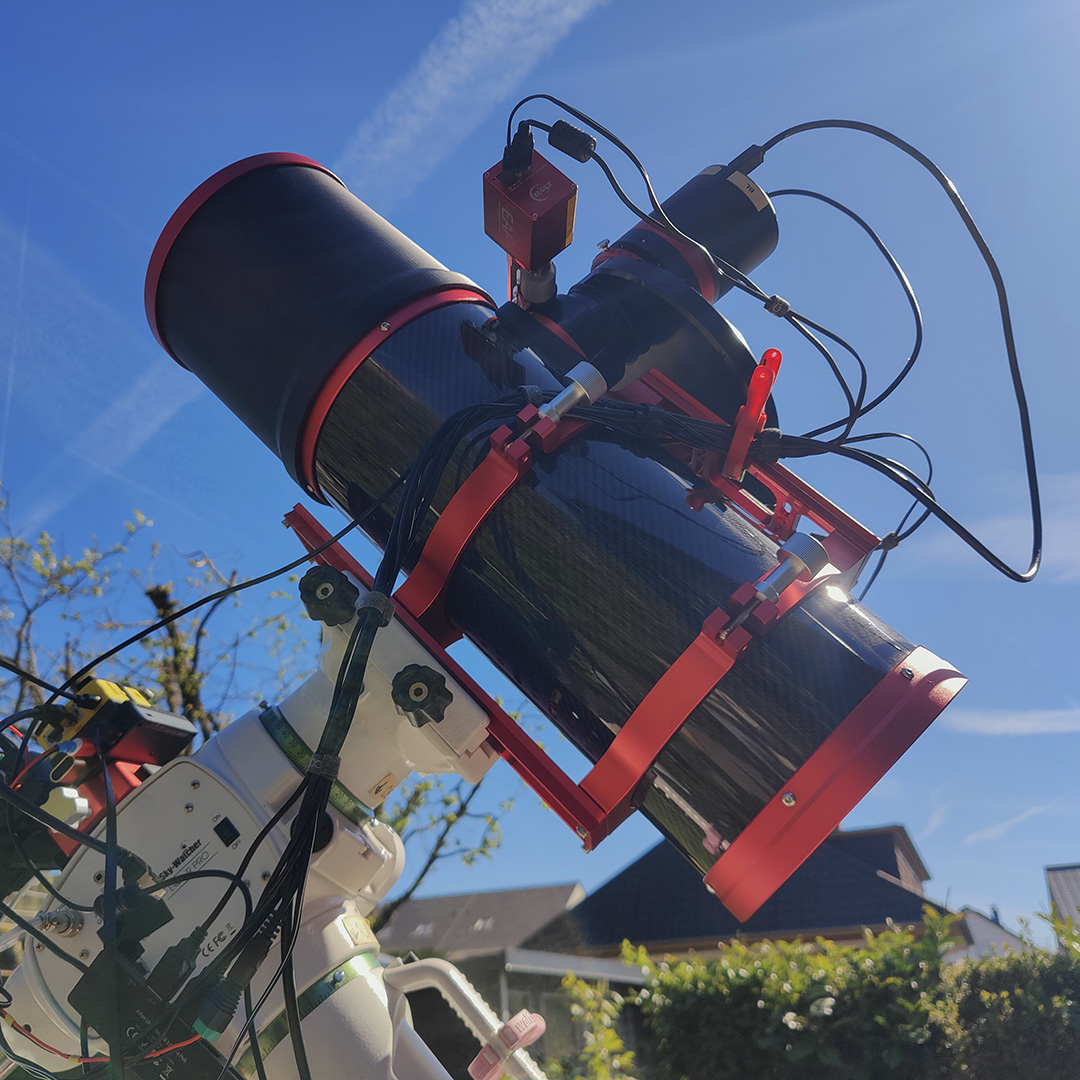
Fast wide-field astrograph
A fast optical system for wide-field targets, nebular regions and efficient night-sky imaging.
Technical glimpse
- Sky-Watcher EQ6 Pro
- Sharpstar 15028HNT f/2.8 Hyperboloid
- QHY268M IMX571
- Svbony LRGB + SHO filters
Milky Way Photography
Our featured workshop within the Nightscape & Milky Way Photography route takes you into the Éislek region for a practical night in the field with your own camera.
Learn how to plan a Milky Way photograph, choose a composition, focus in darkness and find the right exposure and settings for your equipment. Places are limited so the session remains practical, personal and adapted to real night-sky conditions.

Ancient light, public meaning
Astrophotography becomes powerful when it leaves the screen and enters public space.
Nightwise develops curated image collections for exhibitions, schools, municipalities, cultural institutions and outreach programmes. High-resolution imagery and selected raw datasets can support educational material, publications and collaborative astronomy projects.
Ancient Light
Our astrophotography exhibition combines deep-sky images, scientific storytelling, and awareness of light pollution and the value of protecting the night.
Discover Ancient Light →
Find your starting point
The right route depends less on how much you already know and more on what you want to photograph, what equipment you use and where you want to improve.
Which astrophotography learning route should I choose?
Choose the Complete Deep-Sky Astrophotography Course if you want to learn the full telescope imaging process from setup to final image. Choose Nightscape & Milky Way Photography if you want to photograph the night sky and landscape with your own camera. One-to-One Mentoring is best if you already have equipment, images or experience and want help with specific problems or workflow improvements.
Do I need professional equipment?
No. Equipment depends on the route. Nightscape workshops are built around participants’ own cameras and practical field photography. The deep-sky course is specifically aimed at telescope and tracking-based astrophotography, while mentoring can be adapted to your own equipment and experience.
What is the difference between deep-sky and nightscape astrophotography?
Deep-sky astrophotography uses telescopes, tracking mounts and long exposures to record faint objects such as galaxies and nebulae. Nightscape photography combines the visible night sky with the landscape, often including the Milky Way, stars, airglow and recognisable locations.
Can I get help with my own astrophotography setup or images?
Yes. One-to-One Astrophotography Mentoring is designed for this. Sessions can focus on equipment setup, acquisition planning, troubleshooting, image processing or improving an existing workflow.
Can Nightwise create astrophotography exhibitions?
Yes. We develop curated astrophotography exhibitions for schools, municipalities, cultural centres, science events and public outreach programmes.
Why connect astrophotography with light-pollution awareness?
Astrophotography depends on access to dark skies. We use astronomical images to communicate the scientific, cultural and environmental value of protecting the natural night.
Where do you want to start?
Whether you want to build your first complete telescope workflow, photograph the Milky Way, solve a specific astrophotography problem or develop an educational project, tell us what you would like to achieve.